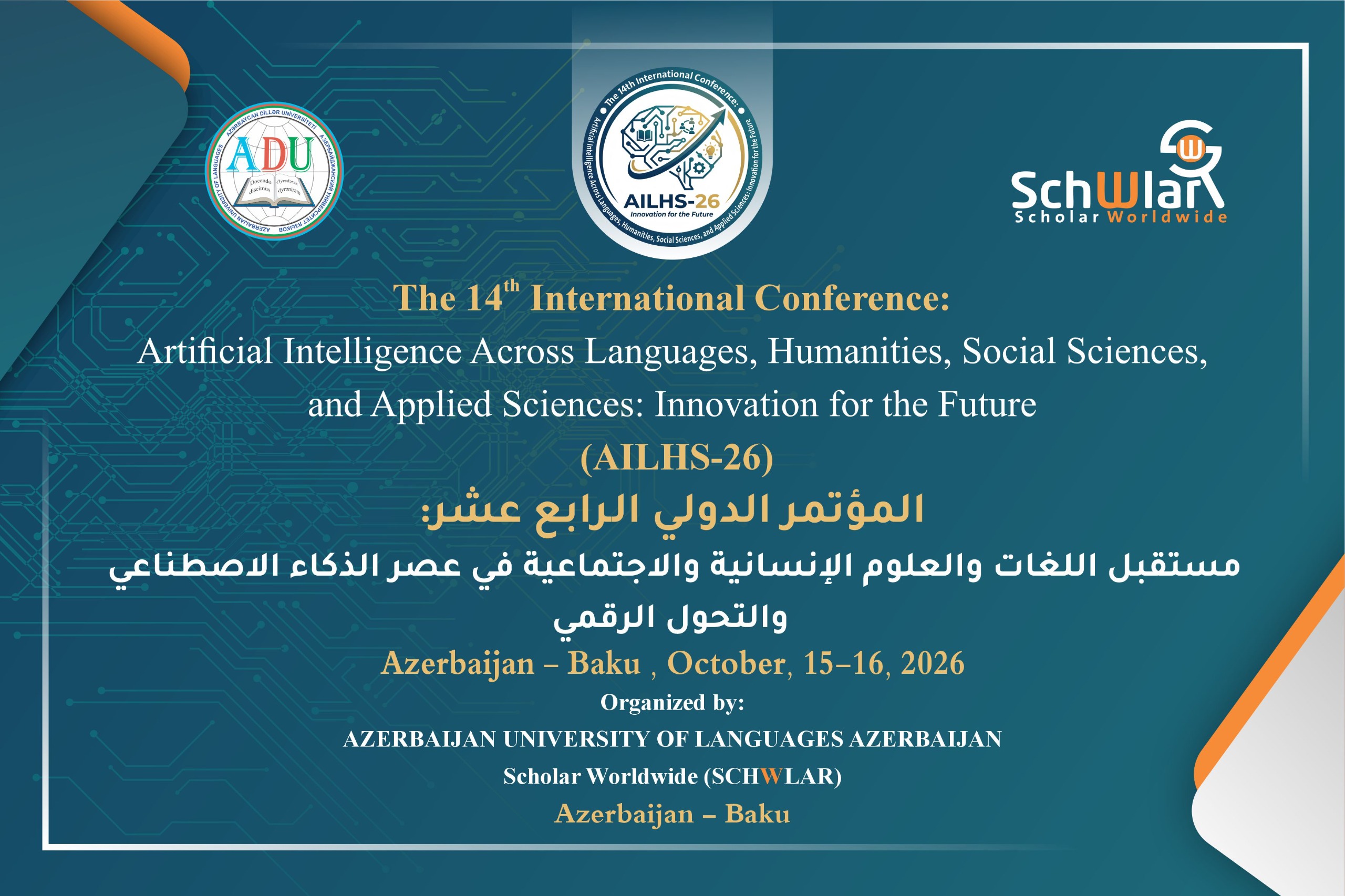
Organized by AZERBAIJAN UNIVERSITY OF LANGUAGES -AZERBAIJAN & Scholar Worldwide (SCHWLAR)
Conference Date: October,15th-16th, 2026
Deadline for submission: September 20th, 2026
Venue: AZERBAIJAN UNIVERSITY OF LANGUAGES -AZERBAIJAN
Keynote Speaker: Prof. Dr. Abdullayev K.M
Rector: Prof. Dr. Abdullayev K.M
The 14th International Conference:
Artificial Intelligence Across Languages, Humanities, Social Sciences, and Applied Sciences:
Innovation for the Future
(AILHS-26)
|
Chairman Prof Dr. Abdullayev K.M. (Rector of Azerbaijan University of Languages, Academician) |
||
|
Vice- Chairman Conference Prof. Dr. Murad H. Al- Abdullah Executive Director Schwlar |
Vice- Chairman Conference Prof. Dr. Aliyeva H.A. Vice-Rector for Science and Innovation, Azerbaijan University of Languages, |
|
|
Head of Organizational Committee Assoc. Prof. Dr. Ulviyya Huseynova Azerbaijan University of Languages Azerbaijan Schwlar |
Head of Scientific Committee Assoc. Prof. Dr. Najeeb Abbas Al Sammarraie Al-Madinah International University (MEDIU) Kuala Lumpur -Malaysia Schwlar |
|
|
External Relations |
||
|
Dr. İlker Özçelik Süleyman Demirel University Turkey Schwlar |
Assoc. Prof . Dr. Abdulrahman Al-Rahmani University of Basra Iraq Schwlar |
|
A Call for scholars & researchers worldwide
Conference Abstract:
Azerbaijan University of Languages (AUL), Azerbaijan, in collaboration with Scholar Worldwide (SCHWLAR), is pleased to invite academics, researchers, professionals, and postgraduate students from around the world to participate in:
The 14th International Conference: Artificial Intelligence Across Languages, Humanities, Social Sciences, and Applied Sciences: Innovation for the Future (AILHS-26)
The rapid advancement of artificial intelligence is reshaping the way knowledge is created, communicated, and applied across diverse academic disciplines. As AI technologies continue to transform education, language studies, translation, communication, humanities, social sciences, and applied sciences, there is a growing need for interdisciplinary collaboration that bridges traditional academic boundaries and fosters innovative solutions to contemporary global challenges.
The conference aims to provide an international platform for scholars, researchers, educators, policymakers, and industry experts to exchange knowledge, present original research, and explore the opportunities and challenges arising from the integration of artificial intelligence into various fields of study. It seeks to promote dialogue on how AI can enhance research quality, support educational innovation, strengthen intercultural communication, advance language technologies, and contribute to sustainable scientific and societal development.
Particular emphasis will be placed on the future of languages and language technologies, digital humanities, translation studies, education, social sciences, computational approaches to research, and the application of artificial intelligence across scientific and professional domains. The conference encourages interdisciplinary contributions that demonstrate how emerging technologies can foster innovation, collaboration, and knowledge transfer between the humanities and applied sciences.
The conference will feature keynote speeches, scientific presentations, panel discussions, and specialized workshops led by distinguished international scholars and experts. It will provide participants with valuable opportunities to establish academic partnerships, develop international research networks, and engage in meaningful discussions on the future of higher education and scientific research in the age of artificial intelligence.
We warmly invite you to join this prestigious international gathering and contribute to shaping new interdisciplinary pathways that connect languages, humanities, and applied sciences through innovation and technological advancement.
Selected papers accepted for presentation will be considered for publication in internationally recognized conference proceedings and indexed publication outlets, subject to the publisher’s review process and publication requirements.
Conference Objectives:
The conference “Artificial Intelligence and the Future of Languages, Humanities, and Applied Sciences: Interdisciplinary Pathways to Innovation (AIFLHAS-26)” seeks to achieve the following objectives:
- Promote Interdisciplinary Research and Collaboration by creating a global platform that brings together researchers and experts from languages, humanities, social sciences, and applied sciences to exchange knowledge and develop innovative research partnerships.
- Explore the Impact of Artificial Intelligence on Languages and Communication through the study of language technologies, machine translation, computational linguistics, multilingual communication, and AI-driven tools that support language learning and cultural exchange.
- Advance Innovation in Education and Higher Learning by examining the role of artificial intelligence in transforming teaching, learning, assessment, curriculum development, and academic administration within educational institutions.
- Foster the Development of Digital Humanities through the integration of artificial intelligence, data analytics, and digital technologies into humanities research, cultural studies, historical analysis, and knowledge preservation.
- Investigate Emerging AI Applications in Social and Human Sciences and evaluate their implications for society, public policy, ethics, governance, media, communication, and sustainable development.
- Encourage the Responsible and Ethical Use of Artificial Intelligence by promoting discussions on ethical frameworks, transparency, privacy, inclusiveness, and the societal impact of emerging technologies.
- Strengthen Research and Innovation in Applied Sciences by exploring AI-driven solutions in engineering, health sciences, environmental studies, business, and other scientific disciplines that contribute to economic and social development.
- Enhance International Academic Cooperation by building sustainable networks among universities, research centers, professional organizations, and industry partners to support collaborative research and knowledge exchange.
- Support Early-Career Researchers and Postgraduate Students by providing opportunities to present their work, receive scholarly feedback, engage with international experts, and expand their professional networks.
- Promote Knowledge Transfer and Societal Impact by encouraging the translation of research outcomes into practical applications, policies, and innovative solutions that address contemporary global challenges.
- Examine the Future of Work and Skills in the AI Era by exploring how artificial intelligence is reshaping professional competencies, workforce development, lifelong learning, and the future of higher education.
- Provide High-Quality Publication Opportunities through internationally recognized publication channels and conference proceedings, supporting the dissemination and global visibility of innovative research contributions.
Conference topics:
We call upon researchers, academics, and postgraduate students from around the globe to submit their research papers and abstracts in alignment with themes of the conference which expects participation from a large number of researchers worldwide. We also encourage those interested in these topics without a research paper to attend the conference sessions.
In line with the conference objectives, the themes are categorized into two sections across the conference sessions:
Section One: Humanities and Social Sciences
This section encompasses the following disciplines:
|
Arabic Language & Linguistics |
Azerbaijan Language & Linguistics |
English & Foreign Languages |
|
Sociology |
Methods of Teaching Arabic & Other Languages to Non-Native Speakers |
Turkish Language & Literature |
|
Education |
Literature & Literary Criticism |
Translation studies & Arts |
|
History & Archaeology |
Media & Communication Technologies |
Journalism & Visual Media |
|
Financial & Banking Sciences |
Economics & Accounting |
Curriculum Analysis & Evaluation Mechanisms |
| Public Administration &
Leadership Skills |
Studies in Islamic Sciences & Comparative Religions |
Modern Educational Measurement & Evaluation |
|
Political Science & International Relations |
Manuscript Authentication & Study
|
Quality and Sustainable Development |
|
Information Management & Electronic Systems |
Library and Digital Information Management |
Geography and Geographic Information Systems (GIS) |
|
Applied Arts & Design |
Cinema, Theater, & Television |
Studies in Curriculum & Education Methodologies |
|
Modern Trends in E-Learning |
Sports Sciences & Physical Education |
Technology & its Application in Social Sciences |
|
Investment and Entrepreneurship |
Artificial Intelligence and its Applications in Education |
Contemporary Digital Studies for Individuals with Special Needs |
|
Human Resource Management |
Public Health & Prevention of
Infectious Diseases |
Philosophy & Intellectual Culture |
|
Legal Studies |
Environment |
Modern Training Arts & Human Development |
|
Security & Strategic Studies |
The Role of International Organizations in Human Security |
Cybersecurity and Information Technology |
Section Two: Scientific Disciplines
This section includes topics related to the natural and applied sciences, structured as follows:
|
Medical Sciences and Pharmacy |
Chemistry | Biology |
Engineering |
|
Sciences |
Physics | Communications & Electronics |
Computer Science |
|
Networking |
Game Theory | Optimization Theory |
Operational Research & Chaos Theory |
|
Computational Algebra (CA) |
Computational Number Theory (CNT) | Statistical Theory |
Differential Equations inApplied Mathematics |
|
Network Security & Cybersecurity |
Computer Security & Cryptography | Artificial Intelligence: AI |
Modeling & Computer Simulations |
|
Internet of Things (IoT) |
Computer Networks & Internet | Natural Language Processing (NLP) |
Data Science |
|
Image Processing & Computer Vision |
Machine Learning & Its Applications | Deep Learning |
Cloud Computing |
Important Dates:
|
July 1st.2026 |
Conference Announcement |
|
September 20st, 2026 |
Abstract Submission Deadline |
|
September 25 th, 2026 |
Application Fees Deadline |
|
September 25 th , 2026 |
Abstract PPT Submission Deadline |
|
October,15th-16th, 2026 |
Conference Dates |
|
October, 16th, 2026 |
Conference Online Sessions |
|
November 15th, 2026 |
Full Paper Submission Deadline |
Abstract Acceptance:
The researcher will be informed of the result of the submitted abstract by the conference’s scientific committee within one week from the date of submission.
Conference Participation Fees:
- Participation Fee for the Research Presentation Only (Excluding Hotel Accommodation):
- Additional Fee for Each Extra Paper/Abstract Submitted by the Same Researcher:
- Participation Fee for Conference Attendance Only (Without Paper Presentation):
- Remote Participation via Zoom Only:
- Participation Fees for Azerbaijani Citizens:
Note:
The fee will be due upon abstract acceptance. Payment instructions for the conference fees will be sent via email. After payment, the researcher will receive an acceptance letter. The researcher must then send the payment confirmation to the conference email or through the conference WhatsApp number. A receipt will be provided afterward.
On-Site Participation Fees Include:
- Meals: lunch for first day of Conference, and refreshments including tea and coffee during the conference sessions.
- Conference Kit: Includes the abstract book with the conference’s international number, along with certificates of participation and attendance.
- Conference Fees Do Not Include Travel Tickets or Visa Fees.
Remote Participation via Zoom Platform Includes:
- Remote Participation Fee via Zoom Platform Only: $150, which requires the following:
- The research must be presented through Zoom platform exclusively, using the PowerPoint template provided by the conference management. The researcher must present with both video and audio, and recorded presentations are not accepted.
- Participants presenting their research via Zoom platform will receive a certificate of participation in the conference.
- Zoom sessions will be separate from in-person sessions and will have a distinct schedule.
Publication of Research Presented at the Conference:
- For Research Written in English:
- Research papers will be published in the conference proceedings book (AIP), which is indexed in SCOPUS or Springer, following peer review, language editing, and plagiarism checking software.
- The publication fees for the proceedings are separate from the conference fees for:
- Springer: 800$
- For Humanities and Social Sciences Research Written in English:
- Publication in SCOPUS-indexed journals will be optional, and publication fees are separate from the conference participation fees.
- Springer SCOPUS-indexed: 800$
- For Humanities and Social Sciences Research Written in English and Arabic will be published in the conference proceedings book and Peer-Reviewed Journals:
- Free of Charge (as a part of the conference fee)
Peer-Reviewed Journals:
The full research presented at the conference will be published in one of the following journals (according to the researcher’s choice) in Arabic Language, as a part of the conference fee:
- Conference Proceedings Book (ISBN:978-9922-9838-9-9), published on Schwlar platform.
- International Journal for Humanities and Social Sciences (IJHS), with the international serial number (EISSN: 2945-4271), published in the Philippines.
- Al-Tasheel Journal, a semi-annual scientific peer-reviewed journal published by Dongola University in Sudan, focused on social and humanities research, with the international serial number (ISSN: 1858-8891).
- Sibawayh Journal: Arabic Language and Education, a peer-reviewed scientific journal affiliated with Sultan Idris Education University, Malaysia, with the international serial number (EISSN: 2716-5515).
- Journal of Arabic Education and Linguisticis (JAEL) a peer-reviewed scientific journal affiliated with Universitas Islam Negeri Alauddin Makassar- Indonesia.
Guidelines for Participation and Publication in the Proceedings Book:
- The paper must align with one of the conference themes.
- The paper should not have been previously published in scientific journals or presented at other conferences.
- The abstract must be sent in accordance with the conference abstract template.
- Attach a short version of the CV with a recent high-quality photograph.
- The submitted paper must adhere to scientific and academic methodology.
- The full research paper must be submitted after the conference for publication in the peer-reviewed journal. It will be peer-reviewed by the journal’s scientific committee. The conference management will not be involved in responses regarding rejected papers.
- The research should not exceed 20 pages (A4 size), including appendices and the list of references.
- For Arabic research papers:
- Use Word format
- Font: Mylotus
- Font Size: 14 for the body text.
- For English research papers:
- Font: Times New Roman
- Font Size: 12 for the body text, 10 for footnotes.
- Page Dimensions: 2.5 cm margins on all sides except the right side (3 cm).
- Line Spacing: 1.5
- Citations should be in accordance with the (APA) style for in-text references.
- All submitted papers will be subjected to Turnitin (Plagiarism Detection). The similarity percentage should be less than 20%.
Submission of Abstracts:
All abstracts should be submitted via the Scholar Foundation website using the designated form. To access the form, click the link below: www.schwlar.com
Contact us:
| Upload the abstract on the Website
For inquiries, send an email |
www.schwlar.com
AILHS-26@schwlar.com |
|
| WhatsApp Chat with Conference Committees | +9647708858195 (Arabic(
+9647713547132 (English) +905069091688 (Turkey) +972592237098 (Palestine) +201288283572 (Egypt) +961-71-166427 (Lebanon) +601116278599 (Malaysia) +9647708858195 (Iraq( +998 907094477 (Uzbekistan) +2347035002859 (Nigeria) +97152-3303585 (UAE) +968 9566 5014 (Oman) +994507518281 (Azerbaijan) +962788497797 (Kuwait) +923184161504 (Pakistan) +6281227880960 (Indonesia) +356 9942 6389 (Malta) +40741029920 (Romania) +919960169960 (India) +963933594849 (Syria) +97339020605 (Bahrain) +249911080001 (Sudan) +33652660605 (France) +962791522838 (Jordan) +34691132283 (Spain) |
|
| Papers are accepted in:
Arabic, English & Azerbaijan language |
www. adu.edu.az/en/ |